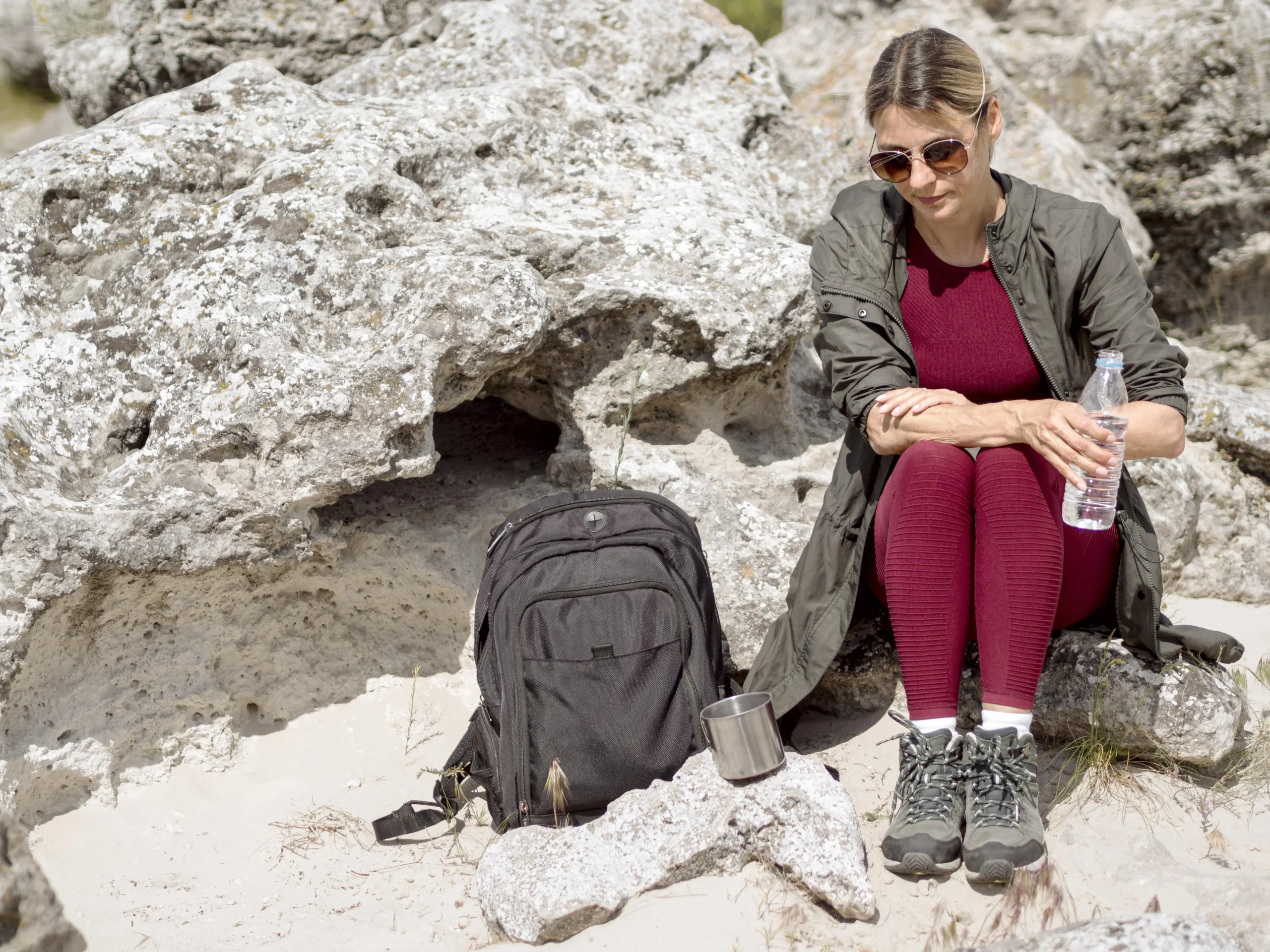
The best hiking outfit ideas right now are the ones that work for the trail in every practical sense – the right shoe, the right layer system, the right fabric for the distance and the weather – while also looking like something you’d be happy to wear in photos at the summit or at the trailhead café after.
I went on a hike a couple of years ago with a group of friends and one of them showed up in exactly this kind of combination – a teal fleece jacket over a white crop tee with black biker shorts and proper hiking boots. She looked genuinely great from the moment we set off to the moment we got back, was appropriately layered for the temperature change between the valley and the ridge, and was comfortable enough in the biker shorts to manage the whole route without any wardrobe management. I asked her afterwards if she’d thought about it specifically and she said she had – she’d realised that most hiking gear looks like hiking gear and she preferred to wear things that could exist outside that context too. That’s the principle this collection is built around.
Our Favorite Hiking Outfit Ideas
The Waterproof Jacket and Beige Hiking Pant
Waterproof hiking jacket, beige hiking pants, trail running shoes. The most technically complete combination in this collection – and the one for any hike where weather unpredictability is part of the equation. A waterproof shell jacket over beige hiking pants with trail running shoes covers every base: the shell handles rain and wind, the beige hiking pant moves freely and dries quickly, and trail running shoes provide the grip and the lightweight comfort that a full boot doesn’t always need to. The beige pant is the colour choice that reads as more personally considered than the standard black or grey alternative. This is the combination for the longer day hike where being caught underprepared for a weather change would genuinely matter.
The Forest Green Hoodie and Hiking Boots
Forest green hoodie, blue hiking shorts, brown hiking boots. A forest green hoodie with blue hiking shorts and brown hiking boots is the hiking combination that reads as most naturally at home in the landscape it belongs to – the forest green echoes the trees, the brown boot echoes the trail, and the whole palette looks like it was drawn from the environment rather than brought from a sports retailer. This is the cooler-morning trail hike outfit – the hoodie handles the start before the exertion warms things up and the shorts handle everything after. Brown hiking boots with blue shorts is a specific colour combination that reads as very deliberately chosen. A very genuine outdoors look with real personal character.
The Oversized White Tee and Biker Shorts
Oversized white tee, black biker shorts, hiking shoes. The most relaxed and most accessible combination in this collection – and perfectly calibrated for the shorter, easier trail that’s more walk than hike. An oversized white tee over black biker shorts with proper hiking shoes (not trainers – the grip and ankle support matter even on an easy trail) is comfortable, practical, and very easy to put together. The biker short is the hiking bottom half that provides the most freedom of movement; the oversized tee provides sun coverage on the arms without adding heat. This is the weekend morning trail combination for the hike that’s more about being outside than pushing distance or elevation.
The Graphic Baby Tee and Grey Shorts
Graphic baby tee, grey hiking shorts, mid hiking boots. A graphic baby tee with grey hiking shorts and mid hiking boots is the hiking outfit with the most personality – the baby tee is a specific style choice that signals personal aesthetic even in a trail context, and with grey hiking shorts and properly specified mid boots it reads as someone who hikes regularly and has figured out how to look like themselves while doing it. The mid boot provides the ankle support a longer trail requires. The grey short is the clean neutral that lets the tee be the focal point. This is the combination for a hike where the trail photos are going somewhere and you want to look genuinely yourself in them.
The Teal Fleece and White Crop Tee
Teal fleece jacket, white crop tee, black biker shorts. The combination my friend wore on that hike – and the one that turned me onto the idea that hiking outfits can look genuinely good rather than just appropriate. A teal fleece over a white crop tee with black biker shorts is the combination that handles the temperature variation of a hike most gracefully – the fleece for the cooler sections, off and tied around the waist for the warmer ones, back on at the top. The teal colour is the specific choice that makes the whole thing feel personally styled rather than generically outdoorsy. With proper hiking boots this combination handles a serious day trail comfortably and looks great doing it.
The Striped Long Sleeve and Yellow Biker Shorts
Striped long-sleeve tee, yellow biker shorts, trail running shoes. The most colourful and most fashion-forward combination in this collection – and the one that most directly demonstrates the point that hiking outfits don’t have to default to any particular palette or visual register. A striped long-sleeve with yellow biker shorts and trail running shoes is a bold, warm-weather hiking combination with genuine visual personality. The long-sleeve provides sun protection on the arms without adding heat in the way a sweatshirt would. Trail running shoes are the right shoe for a hike that stays on a maintained trail without very technical terrain. This is the hiking outfit for someone who dresses with genuine colour confidence and brings it to the trail as readily as anywhere else.
The Pink Zip-Up and Black Leggings
Pink zip-up hiking jacket, black leggings, hiking boots. A pink zip-up hiking jacket with black leggings and hiking boots is the hiking combination that handles cooler weather and more physical trail demands simultaneously. The zip-up provides layering flexibility – fully zipped for the start and the top, open for the warmer sections. Black leggings are the most comfortable and most movement-friendly hiking bottom for temperature-appropriate conditions. The pink jacket is the colour choice that gives this very practical combination its character. Hiking boots provide the support and grip that leggings on more technical terrain require. This is the combination for a serious morning hike in shoulder-season temperatures.
The Sage Green Shell and Grey Hiking Pants
Sage green hiking shell, grey hiking pants, trail running shoes. The sage green shell with grey hiking pants and trail running shoes is the most technically oriented combination in this collection after the beige waterproof version – it reads as the outfit of someone who hikes seriously and knows what gear they need. The sage shell provides wind and light rain protection in a colour that reads as much more personally considered than the standard red or black outdoor shell. Grey hiking pants are the most versatile and most comfortable full-length hiking trouser. Trail running shoes provide the lightweight grip that keeps long-distance trail days comfortable in a way heavier boots don’t. This is the combination for the hiker who cares about both performance and how they look doing it.
My Best Tips for Hiking Outfits
How to dress for an actual hike – practically enough to handle the trail, stylishly enough to feel like yourself doing it.
A hiking outfit has to pass a practical test before anything else – the right shoe for the terrain, the right fabric for the temperature, the right layering system for the conditions. Once those requirements are met, everything else is personal style. Here’s how to meet both sets of requirements simultaneously.
Dress for the Hike, Not Just the Photos
The hiking outfit brief is different from most other outfit briefs because the practical requirements are genuinely non-negotiable. Here’s the guide to calibrating correctly for the specific hike:
- → Easy, maintained trail (2-4km, flat) – a tee or lightweight top, biker shorts or hiking shorts, hiking shoes rather than full boots. The most relaxed hiking combination is appropriate here. Grip and comfort matter; technical support is optional.
- → Moderate trail (4-10km, some elevation) – a layer you can remove (hoodie, fleece, or shell depending on conditions), hiking shorts or pants with a moisture-wicking base, mid or low hiking boots. The shoe matters more here – grip, ankle support, and cushioning for a longer distance.
- → Challenging trail (10km+, significant elevation, technical terrain) – a waterproof shell, proper hiking trousers in a performance fabric, mid or high hiking boots with good ankle support. Weather protection is non-negotiable at this level. Gear quality matters more than aesthetics.
- → The consistent principle: always be dressed for the conditions you might encounter, not just the conditions at the trailhead. Mountains change weather faster than apps predict.
Your Three Hiking Outfit Formulas
Three reliable combinations for three types of hiking day:
The Casual Trail Day
A tee (oversized, graphic, or crop) + biker shorts or hiking shorts + hiking shoes. Maximum comfort, maximum style freedom. The outfit for the easy trail, the nature walk, the hike that’s more about the experience than the technical challenge.
The Layered Moderate Hike
A fleece or zip-up jacket in a colour you love + a crop tee or long-sleeve underneath + biker shorts or hiking shorts + mid hiking boots. The combination that handles temperature variation across the day. The fleece ties around the waist for the warm sections and comes back on for the top and the descent.
The Serious Day Hike
A waterproof shell in a specific colour (sage, pink, forest green rather than the default black) + moisture-wicking base layer + hiking pants or performance leggings + proper hiking boots. Technical performance, personal colour. The outfit that proves you take both the hike and your appearance seriously.
The Hiking Shoe Guide – What to Wear for Which Trail
The shoe is the most important decision in any hiking outfit. Getting it wrong doesn’t just affect the look – it affects the entire experience. Here’s the complete guide:
- → Trail running shoes – lightweight, flexible, excellent grip, dries quickly. Best for maintained trails, easy to moderate terrain, and any hike where distance comfort matters more than ankle protection. Significantly more comfortable for long distances than boots.
- → Low hiking shoes – more structured than trail runners, protective toe cap, better grip on varied terrain. For moderate trails with some rocky or root-heavy sections where ankle support is a mild consideration.
- → Mid hiking boots – the most versatile hiking boot. Ankle support for technical terrain, waterproof options for wet conditions, enough structure for full-day hikes. The right boot for most serious hiking occasions.
- → High hiking boots – for the most technical terrain, multi-day hikes, or hiking with a heavy pack. More ankle support and protection at the cost of flexibility.
- → Never wear standard trainers or casual sneakers on anything beyond a flat park walk – the grip, support, and protection they lack make the experience worse and the risk of injury significantly higher.
The Hiking Layering System
Temperature management is the most important practical aspect of hiking dressing. Here’s the system that works:
- → Base layer – a moisture-wicking tee, crop tee, or long-sleeve. Worn against the skin, moves sweat away, keeps you dry during exertion. Cotton is not the right fabric here – it holds moisture and makes you cold. A synthetic or merino wool base layer is the correct choice for any serious hike.
- → Mid layer – a fleece jacket or zip-up. Warmth without weight. This is the layer you remove and tie around your waist when you warm up and put back on when you stop or when the temperature drops at elevation.
- → Shell layer – a waterproof or wind-resistant jacket. For weather protection. Not always needed but worth having in a pack for any hike where weather is variable or the destination is exposed.
- → The tie-around-the-waist is the most useful on-trail styling move – it keeps the removed layer accessible and adds visual interest to the outline of the outfit. A fleece in a distinctive colour tied at the waist reads as intentional styling rather than just a layer you’re carrying.
The Hiking Colour Palette – Why It Matters
The colour choice in a hiking outfit has both a practical and aesthetic dimension. Here’s how to think about it:
- → Natural colours (forest green, sage, beige, brown) – the palette that reads as most at home in the landscape. Also the palette that photographs most beautifully in outdoor settings against trees, trails, and natural light.
- → Bold colour in a shell or fleece (teal, pink, yellow) – the personality piece that makes a hiking outfit genuinely memorable in photos and on the trail. A colourful outer layer against neutral base layers is the most efficient way to add character to an otherwise technical outfit.
- → Neutral base layers (white, black, grey) – the foundation that works with any outer layer colour. A white crop tee under any fleece or shell reads as clean and deliberate rather than competing with the outer layer.
- → The colour that makes you feel most yourself is the right colour for the trail – the hike photographs better and feels better when you’re wearing something you actually like.
Hiking Bottoms – Biker Shorts vs Hiking Shorts vs Pants
The bottom half is the most practically important decision in a hiking outfit. Here’s the guide:
- → Biker shorts – maximum freedom of movement, no chafing on longer distances, very comfortable for a full hiking day. Best for warmer weather and easier terrain. Look very current and very intentional in a hiking context when paired with an oversized tee or a fleece.
- → Hiking shorts – more coverage than biker shorts, pockets (genuinely useful on trail), and a specific active look that reads as clearly trail-appropriate. Best for moderate terrain in warm weather.
- → Hiking pants – for cooler conditions, more technical terrain, or any hike where leg protection matters (brushy trail, ticks, sun exposure). Performance fabric hiking pants in beige or grey move well and dry quickly.
- → Leggings – for cooler weather and moderate to serious trails. The most comfortable bottom half for a cold-morning hike when paired with a proper shell jacket and mid boots.
What Not to Wear Hiking
The specific things that make a hiking day harder than it needs to be – and that affect both comfort and safety:
- → Cotton base layers – cotton holds sweat and moisture against the skin, which makes you cold when you stop moving and increases chafing over longer distances. Any moisture-wicking synthetic or merino wool is better.
- → Regular trainers or canvas sneakers – inadequate grip for any varied terrain, no ankle support, and sole cushioning that’s not designed for uneven surfaces over extended distances. The difference between proper hiking shoes and regular sneakers on a longer trail is significant.
- → Jeans – heavy, don’t move freely, hold moisture, take hours to dry if they get wet. The wrong fabric and wrong cut for any trail beyond a completely flat park walk.
- → No sun protection – a cap, sun-protective fabric, and sunscreen for any exposed ridge walk or summer hike. The sun at elevation is significantly stronger than at sea level.
- → New shoes on a serious hike – broken-in shoes that have moulded to your foot are significantly more comfortable for a long day on trail than new ones. Never debut hiking boots on a long or technical hike.
The cheat code: A fleece jacket in a colour you genuinely love (teal, pink, forest green, sage) over a white crop tee with black biker shorts and broken-in mid hiking boots is the hiking outfit that handles most moderate trail days, looks genuinely good in every photo from trailhead to summit, and involves a layering system that actually works for the temperature variation a hike produces. The fleece ties around your waist when you warm up, goes back on at the top. The biker shorts move with you completely freely. The specific colour of the fleece is the thing that makes you recognisable as a person with a personal aesthetic rather than just someone in hiking gear.
Copy-Paste Hiking Outfit Template
- ✦ A moisture-wicking base layer – tee, crop tee, or long-sleeve in synthetic or merino (not cotton)
- ✦ Hiking bottoms matched to the conditions – biker shorts (warm, easy), hiking shorts (moderate), pants or leggings (cool, technical)
- ✦ A mid layer in a colour you love – fleece or zip-up, to wear and to tie around the waist
- ✦ A shell layer if the hike warrants it – waterproof for serious or exposed trails
- ✦ The right shoe for the trail – trail runner for easy, mid boot for moderate, serious boot for technical
- ✦ Sun protection – a cap, sun sleeves, or SPF fabric for exposed sections
- Practical enough for the trail. Personal enough to feel like yourself on it.
Frequently Asked Questions
What should I wear for a hiking outfit?
A moisture-wicking tee or crop tee as a base layer, biker shorts or hiking shorts for warmer conditions (hiking pants or leggings for cooler ones), a fleece or zip-up jacket in a colour you love as a mid layer, and proper hiking shoes or boots matched to the trail difficulty. The fleece handles the temperature variation of the hike – worn at the start and end, tied around the waist in between. The specific colour of the fleece or shell jacket is the personality choice that makes the hiking outfit feel genuinely personal rather than generic outdoor gear.
What shoes should I wear for hiking?
Trail running shoes for easy to moderate maintained trails – lightweight, excellent grip, comfortable for long distances. Low hiking shoes for moderate terrain with some rocky or technical sections. Mid hiking boots for serious day hikes with significant elevation, technical terrain, or wet conditions – they provide ankle support and protection that trail runners don’t. The most important rule: break in hiking boots thoroughly before wearing them on a serious hike. New boots on a long trail produce blisters that make the experience genuinely miserable. Regular sneakers or canvas trainers should not be worn on anything beyond a completely flat park walk.
Are biker shorts good for hiking?
Yes – for warmer weather and easier to moderate trails, biker shorts are one of the best hiking bottoms available. They provide maximum freedom of movement, don’t chafe on longer distances, and dry quickly if they get wet from a stream crossing or rain. Paired with an oversized tee or a fleece jacket they look very current and very intentional in a hiking context. For more technical terrain, cooler temperatures, or brushy trails where leg protection matters, hiking shorts with pockets or hiking pants are more appropriate – the biker short leaves the lower leg exposed to scratches, sun, and insects.
What should I not wear hiking?
Jeans (heavy, don’t move freely, hold moisture), regular trainers or canvas sneakers (inadequate grip and support for any varied terrain), cotton base layers (hold sweat and moisture, make you cold when you stop), and new shoes on any serious hike. Sun protection is also non-negotiable on exposed trails – a cap and sun-protective fabric or sunscreen for any ridge walk or summer hike, where the intensity at elevation is significantly higher than at ground level. And always bring more layer than you think you’ll need – temperature at the trailhead and temperature at the summit of most serious hikes are very different numbers.
What colors are best for hiking outfits?
Natural tones (forest green, sage, beige, brown) photograph most beautifully in outdoor settings and read as genuinely at home in the landscape. A bold colour in the mid or shell layer (teal, pink, yellow) is the personality choice that makes a hiking outfit memorable and makes you easily identifiable on the trail – which has both an aesthetic and a practical benefit. White and black as base layers work with any outer layer colour and read as clean and deliberate in outdoor photos. The most important colour rule for hiking: wear something you actually like in the specific colour, because eight hours on a trail is long enough for an outfit you’re not comfortable in to become an outfit you actively resent.