Climbing is one of the few sports where your outfit has to survive direct contact with rock, not just movement around it. Every reach, every high step, every awkward stem across a wide gap tests the outfit in a way running or yoga never will, and a harness is going to sit right at your waist through the whole thing. The best climbing outfits are built around that specific physical reality first, which is exactly why the ones that look effortlessly cool almost always turn out to be the most functional too.
Our Favorite Climbing Outfits
The Beige Climbing Tank Top & Olive Cargo Climbing Pants
Beige climbing tank top, olive cargo climbing pants. A beige climbing tank with olive cargo climbing pants is the outfit that gets the whole brief right from top to bottom – a proper climbing tank is cut close enough to stay out of the way without restricting your shoulders on a reach, and cargo climbing pants bring the articulated knees and gusseted crotch that let you high-step without the fabric pulling. Earth tones like beige and olive are the unofficial uniform of this sport, practical against rock and dirt and never showing wear the way a bright color would. This is the outfit for a full day outdoors, gym or crag, built to move exactly as much as you need it to.
The Plaid Hiking Shirt & Olive Hiking Shorts
Plaid hiking shirt, olive hiking shorts. A plaid hiking shirt with olive hiking shorts is the climbing outfit for the approach as much as the actual climb – a button up hiking shirt layers easily over a base tank and adds sun protection for the walk in, and it’s simple to shed once you’re at the wall and warming up. Hiking shorts underneath give real range of motion for scrambling over uneven terrain before you ever touch rock. This is the combination for the trip that starts with a hike before it gets to the climbing, practical for both halves of the day.
The Pink Zip Up Hiking Jacket & Black Hiking Leggings
Pink zip up hiking jacket, black hiking leggings. A pink zip up hiking jacket with black hiking leggings is the climbing outfit for the cold morning at the crag, before the sun’s fully up and your hands and shoulders need a bit more warmth than a tank alone provides. The zip makes the jacket easy to remove mid-session without stopping to peel a pullover over your head, which matters more than it sounds like once you’re actually climbing. Black hiking leggings underneath move completely freely and layer well under a harness with no bulk at the waist. Pink is a genuine departure from the expected earth tones, proof this sport doesn’t require a strict color rule.
The Brown Performance Tank Top & Olive Cargo Climbing Pants
Brown performance tank top, olive cargo climbing pants. A brown performance tank with olive cargo climbing pants is the climbing outfit with the most tonal, grounded palette – brown and olive sit close together in the earth-tone family, and performance fabric on the tank means it moves and dries fast through a sweaty session on the wall. The cargo pants do the same functional work they do throughout this collection, giving your knees and hips full range of motion for a high step or an awkward reach. This is the combination for someone who’s serious about the sport and dresses like it without a single wasted detail.
The Black Performance T Shirt & Light Grey Climbing Pants
Black performance t shirt, light grey climbing pants. A black performance t shirt with light grey climbing pants is the climbing outfit with the most gym-friendly simplicity – a t shirt gives a bit more shoulder coverage than a tank, useful for indoor walls where the holds can scrape bare skin more than outdoor rock typically does. Light grey climbing pants are a versatile neutral that pairs with nearly any top color, and the articulated fit moves with you through every kind of route. This is the outfit for the regular gym session, simple and repeatable without needing a second thought.
The Black Cropped Tank Top & Sage Green Climbing Pants
Black cropped tank top, sage green climbing pants. A black cropped tank with sage green climbing pants is the climbing outfit built specifically around harness compatibility – the cropped length means there’s zero excess fabric to bunch up under the waist belt, which is a real comfort difference over a long session. Sage green climbing pants bring the same articulated, high-mobility cut as every other technical pant in this collection, with a color that’s soft and easy to pair with almost any top. This is the outfit for someone who’s noticed exactly how much a harness can bother a longer top and solved the problem directly.
The Burgundy Performance Tank Top & Beige Cargo Climbing Pants
Burgundy performance tank top, beige cargo climbing pants. A burgundy performance tank with beige cargo climbing pants is the climbing outfit with the richest color choice in this collection – burgundy is a deep, warm shade that stands out against the expected earth tones without looking out of place among them, and it pairs easily with a neutral like beige underneath. The cargo pants bring the pockets and articulated fit that make this style a genuine favorite among climbers, useful for stashing chalk or a small piece of gear without needing to set down a bag. This is the outfit for adding a little personal color to an otherwise practical, earth-toned wardrobe.
The Black Cropped Hiking Tank & Black Hiking Shorts with Brown Hiking Boots
Black cropped hiking tank, black hiking shorts, brown hiking boots. A black cropped hiking tank with black hiking shorts and brown hiking boots is the climbing outfit for the approach hike specifically, built to get you to the base of the route comfortably before you ever put on climbing shoes. All black on top and bottom is a simple, no-thought combination, and hiking boots with real tread and ankle support matter more on an uneven trail than most people give them credit for. This is the outfit for the trip where the walk in is as much a part of the day as the climb itself.
My Best Tips for Climbing Outfits
How to dress for something that demands full range of motion and has to work under a harness – the fit, the fabric, and the pieces that actually earn their place on the wall.
A climbing outfit has a short, non-negotiable list of requirements before style even enters the conversation: full range of motion, nothing that bunches under a harness, and fabric that can take real contact with rock. Everything else is personal preference layered on top. Here is the framework.
The Climbing Palette
Colors that make sense for a sport spent on rock and dirt:
- → Olive and sage green – the unofficial default colors of climbing pants, practical against rock and dirt and slow to show visible wear.
- → Beige and light grey – versatile neutrals that pair with nearly any top color and hide chalk dust well.
- → Black – the most common top and legging color, simple and easy to mix with any bottom in the rotation.
- → Brown and burgundy – richer, warmer tones that add a bit of personality without breaking from the earth-tone family.
- → Pink – proof the sport doesn’t demand a strict palette, especially for an outer layer worn during the cooler part of the day.
- → What to skip: fabric so light in color it shows chalk and dirt after a single session.
Your Three Climbing Outfit Formulas
Three combinations that cover the full range of a climbing day:
The Gym Session
A performance tank or tee + climbing pants or leggings. Simple, breathable, and repeatable for the regular indoor session.
The Outdoor Crag Day
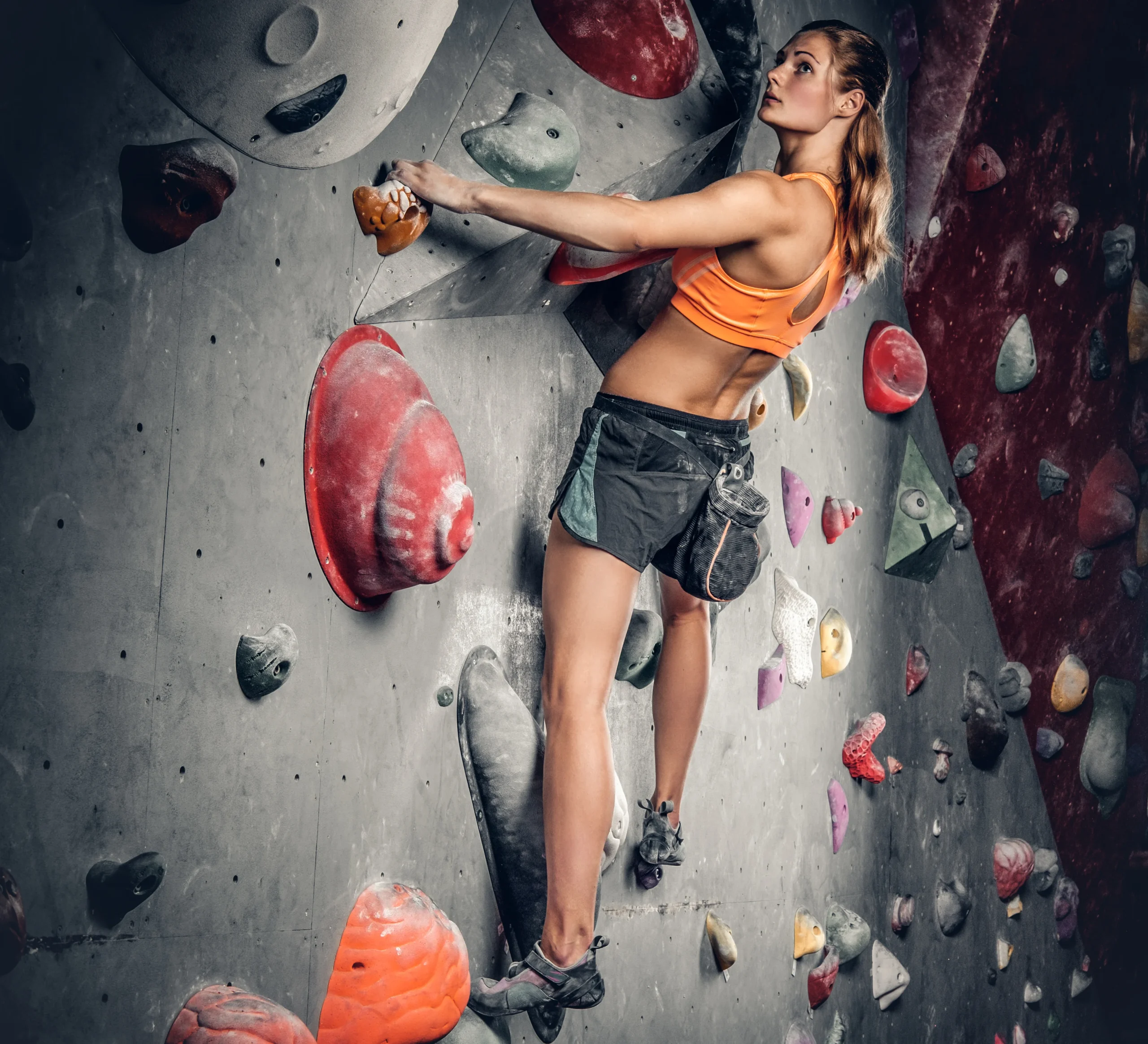
A cropped tank + cargo climbing pants with pockets for chalk and small gear. Built for a full day outdoors with real terrain underfoot.
The Approach Hike
A hiking shirt or jacket + hiking shorts + real hiking boots. The combination for getting to the base of the route comfortably before the climbing starts.
Dressing Under a Harness
The harness sits right at your waist through the entire climb, and it’s worth planning the outfit around:
- → Cropped or fitted tops – the single easiest fix for harness bunching. A longer, looser top rides up and bunches under the waist belt over time.
- → A slim waistband on pants – technical climbing pants are built with this in mind, sitting flat under a harness rather than bunching up.
- → No belt loops with bulky hardware – anything that adds bulk at the waist becomes uncomfortable fast once the harness is cinched.
- → What doesn’t belong: anything with a drawstring or tie that could get caught in gear or the rope system.
The Climbing Fabrics
Fabric has to survive direct contact with rock, which sets a higher bar than most sports:
- → Stretch woven fabric – the standard for climbing pants, built with a bit of give in every direction so a high step or a wide stem doesn’t fight the fabric.
- → Moisture-wicking performance fabric – essential for tanks and tees, since climbing is genuinely strenuous and a session can run long.
- → Ripstop or reinforced weave – built to hold up against rough rock texture and abrasion far better than a regular cotton legging or pant.
- → Breathable outer layers – for a jacket or hiking shirt, letting heat escape during the approach without needing to remove it entirely.
The Climbing Pant – This Sport’s Most Important Piece
No single piece matters more to how well you actually climb than the right pant:
- → Articulated knees are built into a proper climbing pant so the fabric doesn’t pull tight the moment you bend for a high step.
- → A gusseted crotch allows a full leg spread for a wide stem or a reach across a gap without any fabric restriction.
- → Cargo pockets, when included, offer genuinely useful storage for chalk, a small guidebook, or gear you want within reach.
- → A slim, low-profile waistband keeps the pant comfortable under a harness through a full session.
What Climbing Style Is Not
A few boundaries worth knowing before you head to the wall:
- → Not about restrictive fits – anything you can’t fully extend an arm or a leg in isn’t going to work once you’re on a route.
- → Not about regular denim – jeans don’t stretch or breathe the way a proper climbing pant does, and they’ll fight you on every high step.
- → Not about jewelry or loose accessories – anything that could snag on a hold or the rope system is worth leaving at home.
- → Not one outfit for indoor and outdoor – a gym session and an outdoor crag day often call for genuinely different pieces, and that’s expected.
Building the Climbing Wardrobe
The specific pieces that generate every combination in this collection:
- → 1 cropped or fitted performance tank in black and 1 in a warm tone like brown or burgundy
- → 1 performance t shirt for indoor sessions
- → 1 plaid hiking shirt and 1 zip up hiking jacket for layering
- → Cargo climbing pants in olive, beige, sage, and light grey
- → 1 pair hiking shorts and 1 pair black hiking leggings
- → 1 pair black hiking shorts for the approach hike
- → 1 pair sturdy hiking boots with real tread and ankle support
- → From those pieces: every combination in this collection, and a climbing wardrobe built to move exactly as much as you need it to.
The cheat code: A cropped performance tank with a pair of cargo climbing pants is the climbing outfit that handles the most common version of the sport – a real session on the wall, indoor or outdoor. The tank stays clear of the harness with nothing to bunch. The cargo pants give full range of motion for every high step and stem, plus pockets for chalk. Earth tones on the bottom mean it never shows wear the way a lighter fabric would. That is the climbing outfit that solves the actual brief with the least thinking involved.
Copy-Paste Climbing Outfit Template
- ✦ A cropped or fitted top with no bulk under the shoulders or waist
- ✦ A stretch woven or articulated pant, legging, or short built for full range of motion
- ✦ A palette from: olive, sage, beige, light grey, black, brown, or burgundy
- ✦ A slim waistband that sits comfortably under a harness
- ✦ A layer to shed for the cold morning or the approach hike
- ✦ No jewelry, drawstrings, or loose accessories that could snag on gear
- Ready to move. Ready for the harness. Ready for the rock.
Frequently Asked Questions
What should you wear climbing?
A good climbing outfit prioritizes range of motion and harness compatibility above all else – a cropped or fitted top paired with stretch woven climbing pants or leggings covers most sessions, whether indoor or outdoor. Earth tones like olive, sage, and beige are common because they hide chalk and dirt well, though richer colors like burgundy and brown work just as well. A layer like a hiking shirt or jacket is worth having for the approach or a cold morning.
Can you wear leggings for climbing?
Leggings work well for climbing as long as they’re made from a stretch fabric that allows full range of motion, since a high step or a wide stem needs the fabric to move freely. They tend to sit more comfortably under a harness than a looser pant, since there’s less fabric to bunch at the waist. Climbing-specific leggings often add reinforced knees for extra durability against rock contact.
Why do climbing pants have cargo pockets?
Cargo pockets on climbing pants offer genuinely functional storage for chalk, a small guidebook, or gear you want within reach without needing a separate bag. They’re typically positioned to stay out of the way during movement, so they don’t interfere with a high step or a reach the way a poorly placed pocket might.
What should you avoid wearing while climbing?
Regular denim is worth avoiding, since it doesn’t stretch or breathe the way a proper climbing pant does and tends to restrict movement on a high step. Jewelry, drawstrings, and any loose accessories are also best left at home, since they can snag on a hold or the rope system. Anything overly long or loose around the waist can also bunch uncomfortably under a harness.
What should you wear for the hike to a climbing spot?
The approach to an outdoor climbing spot often calls for different clothing than the actual climb – a breathable hiking shirt or jacket, hiking shorts, and sturdy hiking boots with real tread and ankle support handle uneven terrain far better than climbing shoes or a bare tank. Many climbers layer a hiking shirt over their climbing top so it’s easy to shed once they reach the base of the route.