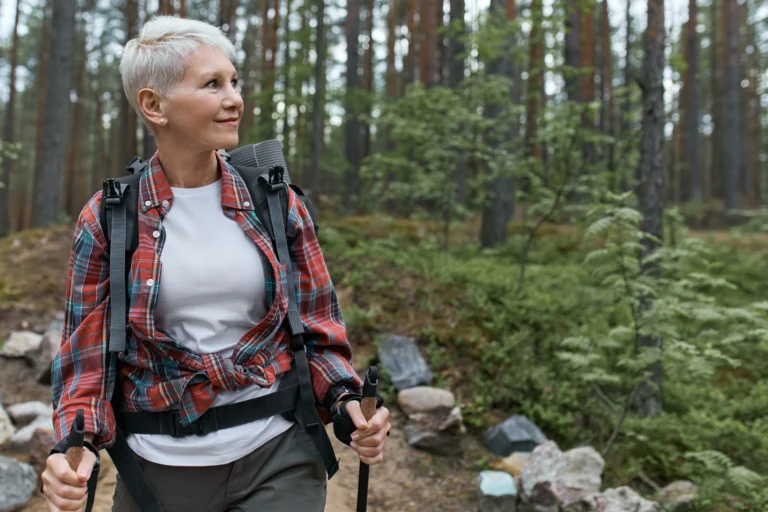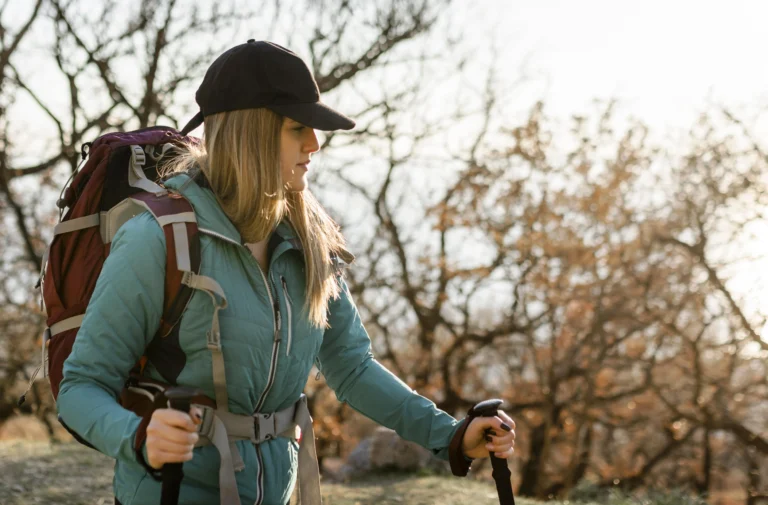
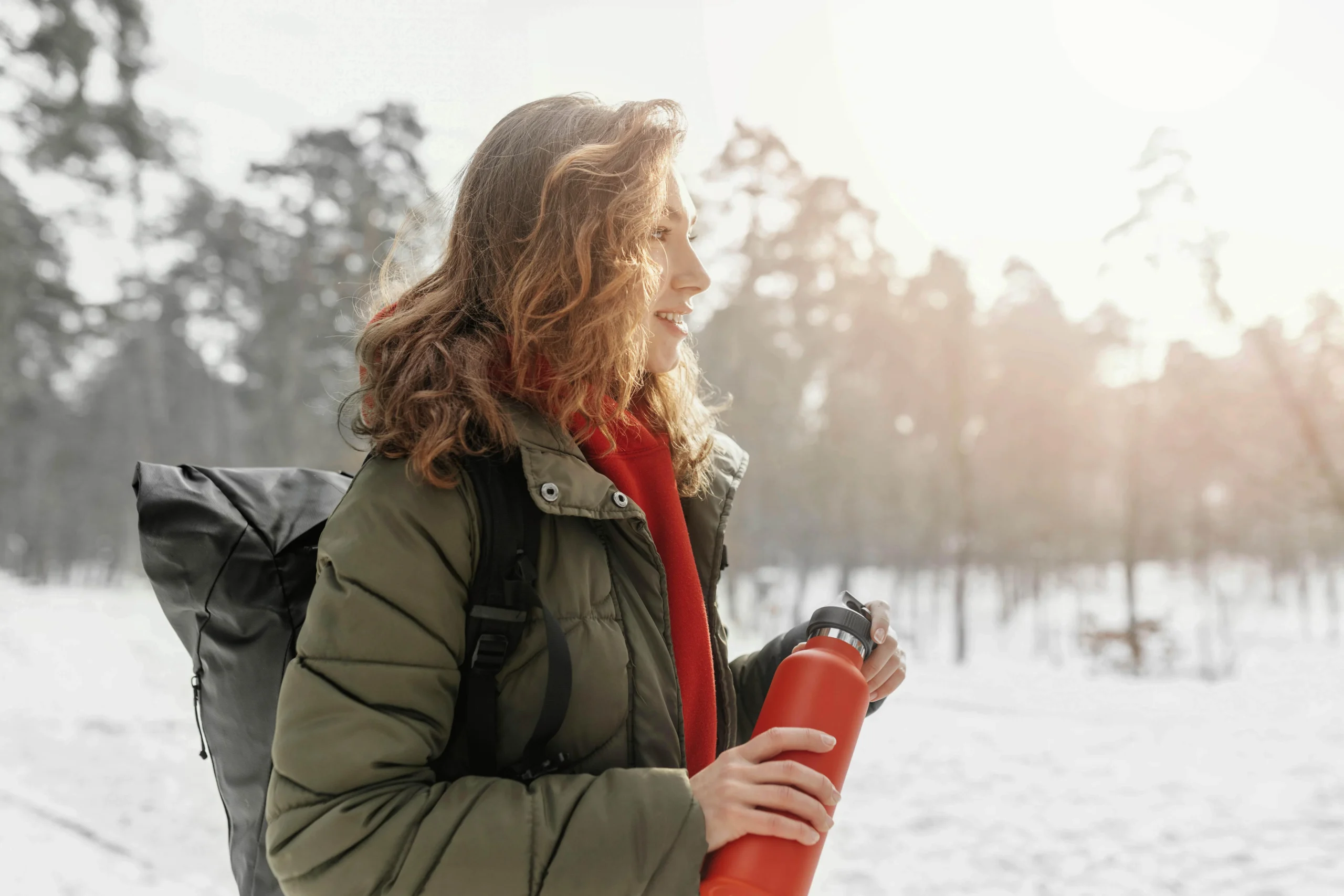
Winter hiking has a specific paradox built into it – you’re cold enough at the trailhead to want every layer you own, and warm enough twenty minutes into the climb to regret half of them. The best hiking outfits for winter are built around solving that paradox rather than just piling on warmth, because too much insulation on a working climb leaves you sweating, and sweat in freezing temperatures is a genuinely bigger problem than the cold itself.
Our Favorite Hiking Outfits for Winter
The Cream Fleece Pullover with Black Leggings and Cozy Socks
Cream fleece pullover, black leggings, hiking sneakers, cozy socks. A cream fleece pullover with black leggings, hiking sneakers, and cozy socks is the outfit for the milder winter day, cold enough for real insulation but not cold enough to need a full puffer or snow gear. Fleece breathes far better than a puffer once you’re actively climbing, which matters more than raw warmth on a working trail. Cozy, thicker socks underneath are doing more for actual comfort than most people give them credit for, since cold feet are one of the fastest ways a winter hike goes wrong. This is the outfit for the crisp but manageable day, warm enough at the trailhead and breathable enough to stay comfortable once you’re moving.
The Forest Green Puffer Jacket with Black Leggings and Brown Beanie
Forest green puffer jacket, black leggings, hiking boots, brown beanie. A forest green puffer jacket with black leggings, hiking boots, and a brown beanie is the outfit for the genuinely cold winter trail, where insulation is doing real, necessary work rather than just adding comfort. Puffer fill traps heat efficiently, and forest green blends naturally into a winter woodland setting without disappearing into it entirely. A beanie is non-negotiable in this outfit, since so much heat is lost through the head that skipping it undercuts everything the jacket is doing. Hiking boots underneath provide real traction for icy or uneven winter ground. This is the outfit for the cold-weather hike that demands serious warmth from the very first step.
The Black Fleece Jacket with Black Hiking Pants
Black fleece jacket, black hiking pants, trail shoes. A black fleece jacket with black hiking pants and trail shoes is the most streamlined winter hiking outfit in this collection – all black keeps things simple, and fleece on top of a proper base layer is genuinely enough insulation for a moderately cold, actively-moving hike without the bulk of a full puffer. Hiking pants underneath bring real durability and enough insulation of their own for a winter trail that isn’t dealing with deep snow. Trail shoes are lighter than a full boot, right for a well-maintained winter trail without significant ice or snowpack. This is the outfit for the regular winter hike, warm without over-layering for a climb that’s going to generate its own heat.
The Black Puffer Vest with Beige Long Sleeve Top
Black puffer vest, beige long sleeve top, black leggings, white sneakers. A black puffer vest over a beige long sleeve top with black leggings and white sneakers is the outfit built around exactly the vest logic that works so well in cold weather – insulating the core, where you lose heat fastest, without covering the arms and risking overheating on a climb. A long sleeve underneath handles the arms with a lighter layer that still offers real warmth. This is the outfit for the winter day that’s cold but not extreme, and for the hiker who runs warm once they’re actually moving and doesn’t want a full jacket fighting against that.
The Coral Hiking Jacket with Beige Knit Scarf and Gray Beanie
Coral hiking jacket, beige knit scarf, gray beanie. A coral hiking jacket with a beige knit scarf and gray beanie is the outfit with the most color and personality in this collection, proof that winter hiking gear doesn’t have to default to black or forest green to perform well. A scarf adds warmth at the neck, a spot that loses heat quickly and is easy to forget about when planning a winter outfit around jackets and pants alone. Coral stands out beautifully against a snowy or overcast winter backdrop, which is a genuine visibility benefit on top of being a nice change from the expected muted palette. This is the outfit for someone who wants winter hiking gear that still feels like their own style.
The Burgundy Puffer Jacket with Charcoal Hiking Pants and Knit Beanie
Burgundy puffer jacket, charcoal hiking pants, black boots, knit beanie. A burgundy puffer jacket with charcoal hiking pants, black boots, and a knit beanie is the outfit with the richest, warmest color story in this collection – burgundy is a deep, considered shade for a puffer that still performs exactly like a more expected black or navy one. Charcoal hiking pants underneath are practical and hide winter trail grime well. Black boots and a knit beanie round out the cold-weather essentials, warm at both ends where it matters most. This is the outfit for the cold day that still wants a bit of richness in its palette, proof winter gear doesn’t have to be visually flat to be functional.
The Pink Fleece Pullover with Black Leggings and White Beanie
Pink fleece pullover, black leggings, trail sneakers, white beanie. A pink fleece pullover with black leggings, trail sneakers, and a white beanie is the softest color combination in this collection – pink is a genuine departure from the usual winter hiking palette, and it works because fleece is doing the real functional job regardless of the color it comes in. Black leggings underneath are the reliable, move-with-you base this whole category depends on. A white beanie ties into the wintry setting rather than standing out from it. This is the outfit for the milder winter trail, proof that function and a gentler color palette aren’t actually in tension.
The Red Puffer Jacket with Black Leggings and Brown Beanie
Red puffer jacket, black leggings, brown hiking boots, brown beanie. A red puffer jacket with black leggings, brown hiking boots, and a brown beanie is the outfit with the most visibility built into its color choice – red stands out clearly against snow or a muted winter landscape, which is a genuine safety benefit on a trail where being spotted from a distance actually matters. The puffer’s insulation handles serious cold, and brown boots and a beanie bring warmth to the two extremities that need it most. This is the outfit for the winter hike in a more remote or less-trafficked setting, where visibility is worth factoring into the color choice from the start.
The Sage Green Hiking Jacket with Black Snow Pants and Gray Beanie
Sage green hiking jacket, black snow pants, winter boots, gray beanie. A sage green hiking jacket with black snow pants, winter boots, and a gray beanie is the most snow-specific outfit in this collection, built for a trail that actually involves deep snow rather than just cold, dry ground. Snow pants are a genuinely different piece of gear from regular hiking pants, with a waterproof, insulated build that keeps moisture out rather than just blocking wind. Winter boots underneath are rated for real cold and often built with better traction for snowpack than a standard hiking boot. This is the outfit for the trail with actual snow on it, dressed for conditions a regular fall or spring hiking outfit was never built to handle.
The Olive Puffer Jacket with Black Leggings and Cream Beanie
Olive puffer jacket, black leggings, gray hiking shoes, cream beanie. An olive puffer jacket with black leggings, gray hiking shoes, and a cream beanie is the outfit with the most versatile winter palette in this collection – olive functions almost like a neutral, easy to build around without needing much coordination. The puffer provides real insulation for a genuinely cold day, and gray hiking shoes are a lighter option than a full boot, appropriate for a winter trail without deep snow or heavy ice. A cream beanie softens the overall palette while still doing the essential job of keeping heat from escaping through the head. This is the dependable, easy-to-repeat winter hiking outfit worth reaching for on the regular cold-weather trail.
My Best Tips for Winter Hiking Outfits
How to dress for a hike that starts freezing and warms up fast – the layers, the extremities, and the pieces that actually matter in the cold.
Winter hiking isn’t solved by piling on the warmest possible layers. It’s solved by layers you can adjust as your own body heat rises and falls throughout the hike, plus real attention to the parts of the body that lose heat fastest. Here is the framework.
The Winter Hiking Palette
Color choice in winter serves a real function, not just a style one:
- → Red and coral – genuinely useful for visibility against snow or a muted winter landscape, a real safety consideration on a less-trafficked trail.
- → Forest green, sage, and olive – blend into a winter woodland setting while still functioning almost like neutrals.
- → Black and charcoal – practical, versatile base colors that hide winter trail grime and pair with anything else in the rotation.
- → Burgundy – a richer, more considered color that still performs exactly like a standard black or navy puffer.
- → Cream, pink, and beige – softer tones proving winter gear doesn’t have to look purely utilitarian to perform well.
- → What to consider: visibility matters more in winter than in any other season, especially on a remote trail or one with limited daylight.
Your Three Winter Hiking Formulas
Three combinations that cover the full range of winter trail conditions:
The Mild Cold Day
A fleece jacket or pullover + leggings or hiking pants + trail shoes. Breathable warmth for a crisp but manageable trail.
The Genuinely Cold Trail
A puffer jacket or vest + leggings or hiking pants + a beanie + hiking boots. Real insulation for a trail that demands it from the first step.
The Snow Trail
A hiking jacket + snow pants + winter boots + a beanie. Built specifically for deep snow and conditions regular hiking gear can’t handle.
Dressing the Extremities
Your head, hands, and feet lose heat fastest and register cold first, which makes them worth prioritizing over an extra body layer:
- → A beanie – close to non-negotiable for any genuinely cold hike, since a significant amount of body heat escapes through the head.
- → Thick, moisture-wicking socks – doing more for overall comfort than most people expect, since cold feet are one of the fastest ways a winter hike goes downhill.
- → A scarf or neck gaiter – covers a spot that loses heat quickly and is easy to forget about when planning around jackets and pants alone.
- → What doesn’t belong: skipping any of these to save weight. They matter more to comfort than an extra body layer usually does.
The Winter Hiking Fabrics
Fabric choice matters more in winter than in any other hiking season:
- → Puffer or down insulation – traps heat efficiently for genuinely cold conditions, best for a slower-paced or standing-still portion of a hike.
- → Fleece – breathes far better than a puffer once you’re actively climbing, making it the better choice for the working sections of a hike.
- → Waterproof, insulated snow pants – a genuinely different piece of gear from regular hiking pants, necessary for any trail with real snowpack.
- → Moisture-wicking base layers – essential under any winter layer, since sweat trapped against skin in cold temperatures becomes a real problem fast.
The Beanie – Winter Hiking’s Most Important Piece
No single item does more for overall warmth relative to its size and weight:
- → A beanie is one of the most effective pieces of winter gear available, since a significant amount of heat escapes through an uncovered head.
- → It’s easy to remove the moment you warm up, unlike a full hood that’s attached to a jacket you may not want to take off.
- → A knit beanie in a neutral or a color that repeats elsewhere in the outfit ties the whole look together with almost no effort.
- → Nearly every outfit in this collection includes one, and that’s not a coincidence.
What Winter Hiking Style Is Not
A few boundaries worth knowing before you head out:
- → Not about maximum warmth – too much insulation on a working climb leads to overheating and sweat, which becomes its own cold-weather problem.
- → Not about one heavy jacket alone – layers that adjust as body heat rises and falls beat a single piece that’s either too warm or not warm enough.
- → Not about cotton – cotton holds sweat and dries slowly, a genuinely dangerous combination once temperatures drop.
- → Not about ignoring snowpack – a trail with real snow needs snow pants and winter boots, not regular hiking gear stretched past what it’s built for.
Building the Winter Hiking Wardrobe
The specific pieces that generate every combination in this collection:
- → 1 puffer jacket in forest green, burgundy, red, and olive
- → 1 black puffer vest
- → 1 cream fleece pullover, 1 pink fleece pullover, and 1 black fleece jacket
- → 1 coral hiking jacket and 1 sage green hiking jacket for snow-specific days
- → 1 beige long sleeve top as a base layer
- → Black leggings and black hiking pants
- → Charcoal hiking pants and black snow pants
- → Hiking sneakers, trail shoes, hiking boots in brown and black, and dedicated winter boots
- → Beanies in brown, gray, white, and cream, plus 1 knit scarf
- → Cozy, moisture-wicking socks
- → From those pieces: every combination in this collection, and a winter hiking wardrobe that adjusts as fast as your own body heat does.
The cheat code: A puffer jacket with leggings, hiking boots, and a beanie is the outfit that handles the most common version of a genuinely cold winter hike. The puffer traps heat efficiently for the coldest stretches. The beanie covers the single biggest source of heat loss on the trail. Hiking boots handle icy or uneven winter ground with real traction. That is the winter hiking outfit worth trusting when the temperature is the main thing you’re planning around.
Copy-Paste Winter Hiking Outfit Template
- ✦ A moisture-wicking base layer, never cotton
- ✦ An adjustable insulating layer – fleece for active climbs, puffer for genuine cold or standing still
- ✦ A hiking pant or snow pant matched to actual trail conditions
- ✦ A beanie, always, plus a scarf or neck gaiter on the coldest days
- ✦ Thick, moisture-wicking socks and boots rated for the actual terrain and cold
- ✦ A palette from: black, forest green, olive, burgundy, red, coral, or cream
- Warm enough to start. Breathable enough to climb. Adjustable the whole way through.
Frequently Asked Questions
What should you wear for winter hiking?
A good winter hiking outfit is built in adjustable layers rather than one heavy piece – a moisture-wicking base layer, a fleece or puffer mid layer depending on the temperature and how active the hike is, and hiking pants or snow pants suited to actual trail conditions. A beanie and thick, moisture-wicking socks matter as much as the body layers, since the head and feet lose heat fastest.
Should you wear a puffer jacket or fleece for winter hiking?
Fleece tends to work better for the active, working parts of a winter hike, since it breathes far more than a puffer once you’re generating real heat from the climb. A puffer jacket is better suited to genuinely cold conditions or a slower pace, since its insulation traps heat efficiently but doesn’t vent excess warmth well. Many winter hikers carry both and switch depending on the pace and temperature.
Why does a beanie matter so much for winter hiking?
A significant amount of body heat escapes through an uncovered head, which makes a beanie one of the most effective, lightweight pieces of gear for staying warm on a winter hike. It’s also easy to remove the moment you warm up, unlike a hood attached to a jacket you might not want to take off entirely.
Do you need snow pants for winter hiking?
Snow pants are necessary specifically for trails with real snowpack, since they’re built with waterproof, insulated fabric that regular hiking pants don’t have. For a cold but dry winter trail without significant snow, regular hiking pants or leggings are usually sufficient, but deep snow conditions call for dedicated snow gear.
What colors are best for winter hiking gear?
Brighter colors like red and coral offer genuine visibility benefits against snow or a muted winter landscape, which matters on a remote or less-trafficked trail. Forest green, sage, and olive blend naturally into a winter woodland setting while still functioning like neutrals. Darker colors like black and charcoal are practical for hiding trail grime, and richer tones like burgundy add personality without sacrificing function.