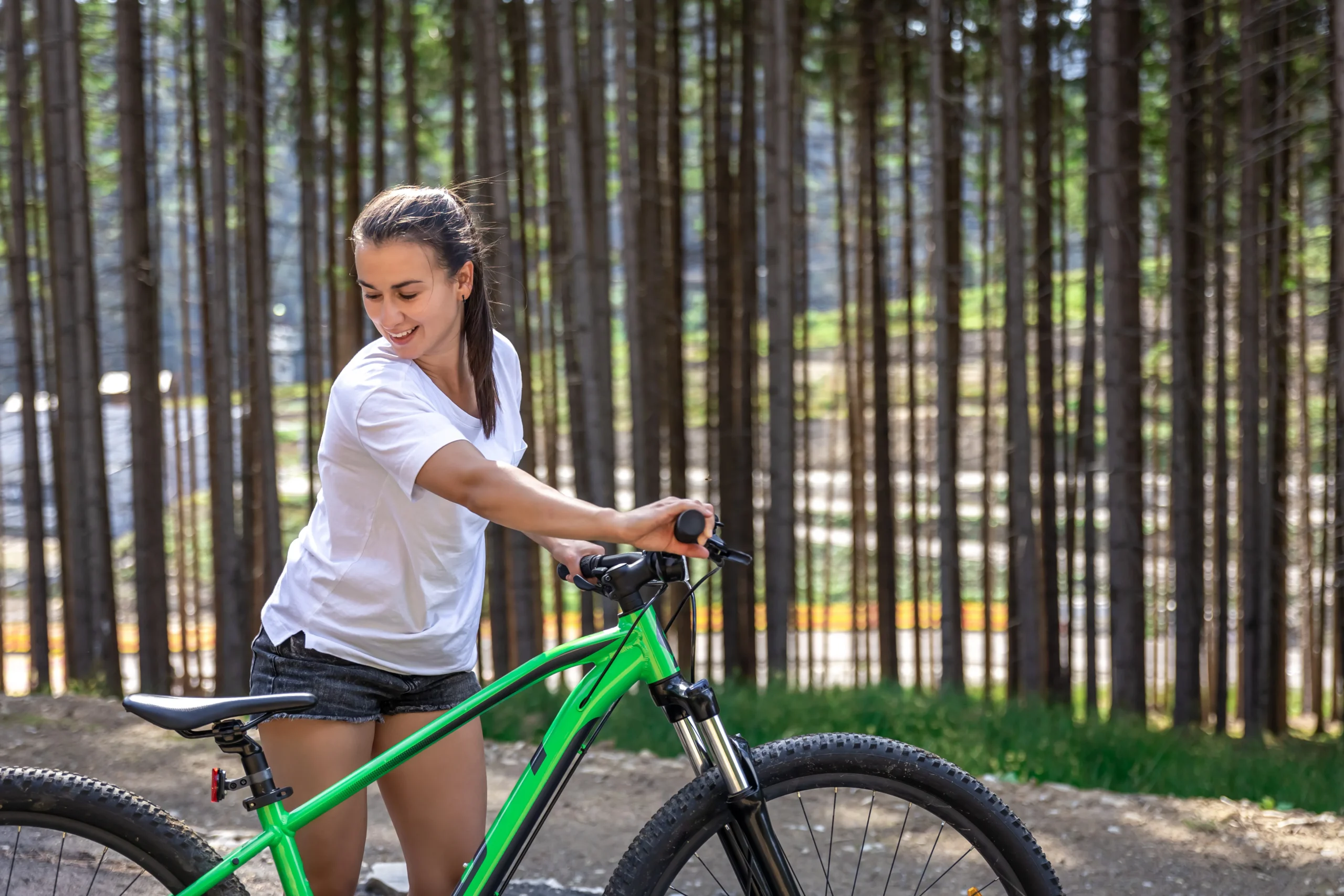
Mountain biking asks something of an outfit that road cycling never does – the real possibility of going down, hard, on rock and dirt rather than pavement. That single fact changes almost every decision, from fabric durability to how much of the body actually needs padding. The best mountain biking outfits are built around that reality first, which is exactly why this category looks so different from a sleek road kit even though both involve two wheels and a lot of pedaling.
Our Favorite Mountain Biking Outfits
The White Long-Sleeve Cycling Top with Olive Shorts and Knee Pads
White long-sleeve cycling top, olive shorts, knee pads, trail shoes. A white long-sleeve cycling top with olive shorts, knee pads, and trail shoes is the outfit that gets the actual protection priorities right – long sleeves guard the arms against brush and branches on a singletrack trail, and knee pads cover the joint most likely to take a hard hit on a technical descent. Olive shorts are durable and hide dirt well, and trail shoes provide the grip needed for technical terrain both on and off the bike. This is the outfit for the ride with real elevation change and rougher trail conditions, dressed with the seriousness that kind of riding actually calls for.
The Mint Green MTB Jersey with Black Biker Shorts and Cycling Gloves
Mint green MTB jersey, black biker shorts, cycling gloves. A mint green MTB jersey with black biker shorts and cycling gloves is the outfit for the shorter, less technical ride where full protective gear isn’t strictly necessary but real functional pieces still matter. A proper MTB jersey has moisture-wicking fabric and pockets built specifically for a bike, more functional than a regular tee. Cycling gloves protect the palms from vibration and provide real grip on the handlebars, a genuinely useful piece regardless of trail difficulty. Mint green is a fresh, visible color against a wooded trail backdrop. This is the outfit for the regular trail ride, comfortable and appropriately equipped without overloading on gear.
The Purple Graphic Cycling Jersey with Black Leggings and Trail Shoes
Purple graphic cycling jersey, black leggings, gloves, trail shoes. A purple graphic cycling jersey with black leggings, gloves, and trail shoes is the outfit with the most personality in this collection – a graphic jersey adds visual interest that a plain top wouldn’t have, and purple is a genuine departure from the expected earth tones or muted neutrals elsewhere in this category. Black leggings underneath move freely with every pedal stroke and stand of the ride, and trail shoes handle the grip demands of technical terrain. This is the outfit for someone who wants their mountain biking wardrobe to reflect actual personal style, not just function.
The Navy Long-Sleeve Cycling Top with Green Shorts and Knee Pads
Navy long-sleeve cycling top, green shorts, knee pads, mountain bike gear. A navy long-sleeve cycling top with green shorts, knee pads, and mountain bike gear is the outfit for the technical trail with genuine crash risk built into the terrain – the same long sleeve and knee pad logic as the earlier protective combination in this collection, with a navy and green color pairing that reads outdoorsy without leaning fully into the expected olive and khaki palette. This is the outfit for the rider who takes the technical sections seriously, protected in the spots that actually need it.
The Black Long-Sleeve Cycling Top with Burgundy Trail Pants and Gray MTB Shoes
Black long-sleeve cycling top, burgundy trail pants, gray MTB shoes. A black long-sleeve cycling top with burgundy trail pants and gray MTB shoes is the outfit with the richest color pairing in this collection – burgundy is a genuinely unexpected trail pant color, warm and distinctive against the black top above it. Trail pants offer more coverage than shorts, useful for a colder day or a trail with heavier brush. Gray MTB shoes are built with a stiffer sole for pedaling efficiency and a grippy tread for hike-a-bike sections. This is the outfit for the cooler ride or the trail dense enough that full leg coverage genuinely matters.
The White Base Layer with Navy Biker Shorts and Hydration Vest
White base layer, navy biker shorts, hydration vest, blue cycling shoes. A white base layer with navy biker shorts, a hydration vest, and blue cycling shoes is the outfit built specifically around a long, remote ride – a hydration vest keeps water accessible without needing to stop and dig through a bag, essential for a backcountry loop with no water source along the way. A lightweight base layer wicks moisture efficiently during sustained effort, and blue cycling shoes bring genuine pedaling performance. This is the outfit for the long-distance ride where hydration planning matters as much as the outfit itself.
The White Sports Bra with Navy Biker Shorts and Hydration Pack
White sports bra, navy biker shorts, hydration pack, cycling gloves. A white sports bra with navy biker shorts, a hydration pack, and cycling gloves is the outfit for the hot-weather ride where minimal fabric is the actual comfort priority – a sports bra alone keeps you cool through a demanding climb, and a hydration pack on top provides the same water-access benefit as a vest without needing a full top layer underneath it. Cycling gloves protect the palms regardless of how minimal the rest of the outfit is. This is the outfit for the summer trail day, stripped down to exactly what the heat and the distance actually require.
The White Cycling Jacket with Black Pants and Padded Vest
White cycling jacket, black pants, padded vest, trail backpack. A white cycling jacket with black pants, a padded vest, and a trail backpack is the outfit for the cold or wet ride, where a real outer layer matters as much as anything worn underneath it. A cycling jacket blocks wind on a fast descent, and a padded vest adds core protection without restricting arm movement on technical sections. A trail backpack carries tools, a spare tube, and extra layers for a ride where conditions might shift. This is the outfit for the early season or high-elevation ride where the weather is as much a factor as the terrain.
The All-Black Long-Sleeve Crop Top with Black Leggings and White MTB Shoes
All-black long-sleeve crop top, black leggings, white MTB shoes. An all-black long-sleeve crop top with black leggings and white MTB shoes is the simplest, most streamlined outfit in this collection – a crop top keeps the midsection cool while the long sleeves still protect the arms, and all black underneath means dirt and trail grime barely show. White MTB shoes are the one contrasting detail, practical and easy to spot if you ever need to find them after setting them down trailside. This is the outfit for the rider who wants function without any real thought given to color coordination beyond one simple contrast point.
My Best Tips for Mountain Biking Outfits
How to dress for a sport with a real chance of going down hard – the protection, the hydration, and the pieces that actually earn their place on the trail.
Mountain biking has a genuinely different risk profile than road cycling, and the outfit should reflect that before it reflects anything else. Protection, hydration, and durable fabric come first; personal color and style get to happen around those priorities. Here is the framework.
The Mountain Biking Palette
Color choice serves visibility and dirt-hiding as much as personal style:
- → Black and navy – the most practical base colors, hiding trail dirt and mud far better than a lighter shade.
- → Olive and green – practical earth tones that also blend naturally with a wooded trail environment.
- → White – genuinely useful for a top layer worn on a hot day, since it reflects heat, though it shows dirt fastest.
- → Mint, purple, and burgundy – genuine personal color choices, proof this category has room beyond the expected muted palette.
- → Bright colors on the top layer – improve visibility to other riders on shared or multi-use trails, a genuine safety benefit.
- → What to skip: worrying too much about staying clean. Dirt is simply part of the sport.
Your Three Mountain Biking Formulas
Three combinations that cover the full range of a ride, casual to technical:
The Technical Descent
A long-sleeve top + shorts or leggings + knee pads + trail shoes. Real protection for the terrain most likely to cause a fall.
The Long Backcountry Loop
A base layer or jersey + biker shorts + a hydration vest or pack. Built around water access for a ride with no stops along the way.
The Easy Trail Day
A jersey + biker shorts + gloves. Comfortable and appropriately equipped without full pad protection for a less technical ride.
Protective Gear Worth Prioritizing
Mountain biking carries real crash risk, and a few pieces genuinely earn their place beyond styling:
- → Knee pads – worth wearing on any technical or unfamiliar trail, protecting the joint most likely to take a hard impact.
- → Long sleeves and long pants – guard against brush, branches, and scrapes on singletrack, more protective than shorts and short sleeves.
- → Cycling gloves – protect the palms from vibration and provide grip, useful on nearly every ride regardless of technicality.
- → What doesn’t belong: skipping protective gear because a trail looks easy. Conditions and terrain change fast on a mountain bike ride.
The Mountain Biking Fabrics
Fabric has to handle both performance and durability against rougher terrain than road cycling:
- → Moisture-wicking synthetic fabric – the standard for jerseys and base layers, keeping sweat off the skin during sustained effort.
- → Ripstop or reinforced weave – for shorts and pants, standing up to brush, rocks, and the occasional fall better than a basic fabric.
- → Padded chamois fabric – built into biker shorts for comfort during long saddle time, genuinely different from a regular legging.
- → Windproof jacket fabric – blocks wind on a fast descent without trapping heat generated on the climb.
Hydration – This Sport’s Most Overlooked Gear
No single decision matters more on a long ride than how you’re carrying water:
- → A hydration vest or pack keeps water accessible without stopping, essential for a backcountry ride with no water source along the way.
- → A vest sits closer to the body than a full pack, useful when technical maneuvering matters more than storage capacity.
- → A backpack offers more room for tools, a spare tube, and extra layers, worth the added bulk on a longer or more remote ride.
- → Even a shorter ride benefits from planning hydration ahead of time, since trail access to water is rarely guaranteed.
What Mountain Biking Style Is Not
A few boundaries worth knowing before you head to the trailhead:
- → Not the same as road cycling – the crash risk and terrain are different enough to genuinely justify different gear priorities.
- → Not about skipping pads on a familiar trail – conditions and confidence change fast, and protection matters regardless of how well you know the route.
- → Not about staying clean – dirt and trail grime are simply part of the sport, not a sign anything went wrong.
- → Not about ignoring hydration planning – a backcountry ride without a water plan is a genuinely different risk than one with a vest or pack.
Building the Mountain Biking Wardrobe
The specific pieces that generate every combination in this collection:
- → 1 white long-sleeve cycling top and 1 navy long-sleeve cycling top
- → 1 mint green MTB jersey and 1 purple graphic cycling jersey
- → 1 black long-sleeve cycling top and 1 white base layer
- → 1 all-black long-sleeve crop top and 1 white sports bra
- → 1 white cycling jacket and 1 padded vest
- → Olive shorts, green shorts, black biker shorts, navy biker shorts, and burgundy trail pants
- → Black leggings and black pants
- → 1 pair knee pads and 1 pair cycling gloves
- → Trail shoes, gray MTB shoes, blue cycling shoes, and white MTB shoes
- → 1 hydration vest, 1 hydration pack, and 1 trail backpack
- → From those pieces: every combination in this collection, and a mountain biking wardrobe built around real protection and real terrain.
The cheat code: A long-sleeve cycling top with durable shorts, knee pads, and trail shoes is the outfit that handles the widest range of mountain biking conditions with the least risk. Long sleeves protect against brush and scrapes. Knee pads cover the joint most likely to take a hard hit on a technical section. Trail shoes grip both the pedal and the ground for any hike-a-bike moment. That is the mountain biking outfit worth trusting when the terrain is doing more of the deciding than the weather is.
Copy-Paste Mountain Biking Outfit Template
- ✦ A moisture-wicking top – long sleeve for protection, jersey or sports bra for casual heat
- ✦ Durable shorts, leggings, or trail pants built to handle brush and a possible fall
- ✦ Knee pads for any technical or unfamiliar trail
- ✦ A palette from: black, navy, olive, green, white, or one genuine color like mint or purple
- ✦ A hydration vest or pack for any ride longer than an hour or without water access
- ✦ Trail or MTB shoes with real grip for pedaling and hike-a-bike sections
- Protected where it counts. Hydrated the whole ride. Ready for the trail to change fast.
Frequently Asked Questions
What should you wear mountain biking?
A good mountain biking outfit prioritizes protection and durability – a moisture-wicking long-sleeve top or jersey paired with durable shorts, leggings, or trail pants covers most rides, with knee pads added for technical or unfamiliar terrain. Cycling gloves protect the palms and improve grip on nearly any ride. A hydration vest or pack is worth adding for longer or more remote rides without water access along the way.
Are knee pads necessary for mountain biking?
Knee pads are widely recommended for technical or unfamiliar trails, since the knee is one of the joints most likely to take a hard impact during a fall. They’re less essential for very easy, non-technical trails, but many riders choose to wear them regardless, since trail conditions and confidence can change quickly during a ride.
Why do mountain bikers wear long sleeves instead of short sleeves?
Long sleeves protect the arms from brush, branches, and scrapes commonly encountered on singletrack trails, offering more coverage than short sleeves without significantly compromising breathability in a good moisture-wicking fabric. This makes long sleeves a common choice for more technical or overgrown trails specifically.
Do you need a hydration pack for mountain biking?
A hydration vest or pack is especially useful for longer rides or backcountry trails without water sources along the way, keeping water accessible without needing to stop. For shorter rides near amenities, a water bottle on the bike frame may be sufficient, but many riders still prefer a vest or pack for the convenience and extra storage it provides.
What fabric is best for mountain biking clothing?
Moisture-wicking synthetic fabric is the standard for jerseys and base layers, keeping sweat off the skin during sustained effort. Shorts and pants benefit from a ripstop or reinforced weave that holds up to brush, rocks, and the occasional fall. Padded chamois fabric built into biker shorts adds genuine comfort for long stretches of saddle time.