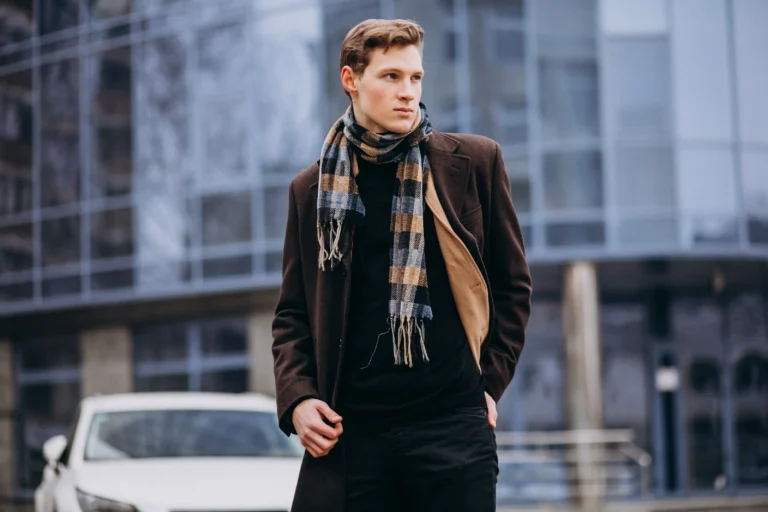

Most men don’t actually need more clothes for work. They need the clothes they already have to combine into more outfits. A closet with fifteen mismatched pieces that don’t talk to each other produces fewer real options than a closet with eight pieces that were chosen specifically to mix and match. That’s the whole logic behind building work outfits for men around a small, deliberate rotation rather than accumulating individual outfits one at a time.
Our Favorite Work Outfits for Men
The Grey Crewneck Sweater with White Dress Shirt and Black Trousers
Grey crewneck sweater, white dress shirt, black trousers, black loafers. A grey crewneck sweater over a white dress shirt with black trousers and black loafers puts three of this wardrobe’s hardest-working pieces together at once – the white shirt and black trousers both reappear in several other outfits in this collection, which is exactly why they’re worth owning in the first place. The grey sweater adds warmth and a small amount of visual texture without introducing a color that needs its own separate coordination plan. This is the outfit that shows how much mileage a genuinely versatile shirt and trouser can generate on their own.
The Beige Harrington Jacket with White Shirt and Charcoal Trousers
Beige Harrington jacket, white shirt, charcoal trousers, brown dress shoes. A beige Harrington jacket over a white shirt with charcoal trousers and brown dress shoes reuses the same white shirt from the outfit before it, this time under a jacket instead of a sweater. That’s the entire point of a small, interchangeable rotation – the shirt doesn’t care what’s layered over it, and the jacket doesn’t care what shirt it’s covering. Charcoal trousers are close enough in tone to black to pair with most of the same shoes and tops without needing to be treated as a separate wardrobe category. This is the outfit that proves one good jacket can cover the cooler days without duplicating anything already in the closet.
The Taupe Polo Shirt with Black Tailored Trousers and Brown Oxford Shoes
Taupe polo shirt, black tailored trousers, brown Oxford shoes. A taupe polo shirt with black tailored trousers and brown Oxford shoes is the outfit for the warmer day when a layered look isn’t necessary at all – the same black trousers from the first outfit in this collection show up again here, now paired with a completely different top and shoe combination. That’s the trousers doing exactly the job a rotation piece is supposed to do, working just as well alone as they do under a sweater. A single taupe polo adds a genuine third color option without requiring its own matching bottom.
The Navy Blazer with Navy T-Shirt and Beige Chinos
Navy blazer, navy t-shirt, beige chinos, brown loafers. A navy blazer over a navy t-shirt with beige chinos and brown loafers introduces the wardrobe’s one structured jacket, chosen specifically because it works over nearly every top color already established in this collection – white, grey, or, as shown here, matched tonally to a navy tee underneath. Beige chinos are the wardrobe’s second bottom color, different enough from black and charcoal to add real variety without requiring a whole new shoe or shirt category to support it. This is the outfit that shows how one blazer multiplies the usefulness of everything already in the rotation.
The Navy Quarter-Zip Cable-Knit Sweater with Dress Shirt and Grey Trousers
Navy quarter-zip cable-knit sweater, dress shirt, grey trousers, brown shoes. A navy quarter-zip cable-knit sweater over a dress shirt with grey trousers and brown shoes brings the wardrobe’s second sweater into rotation, distinct enough in texture from the grey crewneck to feel like a genuinely different outfit even though the underlying shirt is the same piece worn earlier in this collection. Grey trousers are close enough to the black and charcoal already established to pair with the same brown shoes without any real planning. This is the outfit that shows how adding one textured sweater, rather than a whole new outfit, expands the entire rotation.
The Sage Green Sweater with White Shirt, Black Tie and Wide-Leg Trousers
Sage green sweater, white shirt, black tie, wide-leg trousers, black loafers. A sage green sweater over a white shirt with a black tie, wide-leg trousers, and black loafers is the outfit for the one meeting or presentation day that actually calls for a tie, built by adding exactly two new pieces, the sweater and the tie, to a foundation that’s already established. The white shirt, black loafers, and general formula are all pulled straight from earlier in this collection. This is the outfit that shows a wardrobe built for versatility doesn’t need a separate formal capsule; it just needs one or two pieces that can scale the existing rotation up when the day calls for it.
The Light Grey Blazer with White T-Shirt and Navy Trousers
Light grey blazer, white t-shirt, navy trousers, white sneakers. A light grey blazer over a white t-shirt with navy trousers and white sneakers is the second blazer in this collection, distinct enough in color from the navy one to read as a genuinely different outfit while still following the exact same formula. White sneakers are the one shoe in this rotation that reads more casual than the loafers and Oxfords elsewhere, worth including specifically for the office culture that allows it. This is the outfit that shows how two blazers in different tones, rather than five, can cover a surprising range of days on their own.
The Navy Overshirt with Light Grey Polo and Beige Chinos
Navy overshirt, light grey polo, beige chinos, brown sneakers. A navy overshirt over a light grey polo with beige chinos and brown sneakers is the most casual outfit in this collection, built entirely from pieces that have already appeared elsewhere – the beige chinos from the blazer-and-tee outfit, a polo in the same family as the taupe one worn earlier, and an overshirt that functions the same way the Harrington jacket does, adding structure without needing to match anything specific underneath it. This is the outfit that closes out the rotation, proof the same eight or nine pieces can stretch from the most formal day to the most relaxed one.
My Best Tips for Building a Work Wardrobe
How a small number of well-chosen pieces outperforms a closet full of one-outfit purchases – the rotation logic, the multi-duty pieces, and what to prioritize buying.
The goal of a work wardrobe isn’t owning a lot of clothes. It’s owning a small number of pieces that each work in several different outfits, so the total number of possible combinations stays high even as the closet stays small. Here is the framework.
Choosing a Rotation-Friendly Palette
A small number of colors that all pair with each other multiplies outfit combinations fast:
- → White – the single most valuable shirt color, since it works under every sweater, blazer, and jacket in a rotation without exception.
- → Black, charcoal, and grey – close enough in tone to function as one flexible trouser category rather than three separate ones.
- → Navy – the most versatile jacket and sweater color, pairing with nearly every trouser shade already in the rotation.
- → Beige and taupe – the wardrobe’s second bottom and shirt family, adding real variety without needing new shoes to support it.
- → One genuine accent color – like sage green, worth including once the neutral foundation is solid, since it adds variety without threatening the rotation’s flexibility.
- → What to skip: any color that only works with one specific piece already owned. If it doesn’t multiply outfit options, it’s not earning its space.
Your Three Wardrobe-Building Priorities
Three categories worth focusing on before anything else:
One or Two White Shirts
The single highest-mileage piece in any work wardrobe, working alone or under nearly anything else already owned.
Two Trousers in Adjacent Neutrals
Black or charcoal plus one warmer neutral like beige, chosen specifically so both pair with the same shoes.
One Blazer or Structured Jacket
Multiplies every other piece’s usefulness, capable of elevating a plain tee the same way a collared shirt does.
Testing a Piece Before Buying It
The real question for any new work piece isn’t whether it looks good once, it’s how many existing outfits it can join:
- → Count the combinations – a piece that only works with one thing already owned is a much weaker purchase than one that works with three or four.
- → Check the shoe compatibility – a new trouser color is only as useful as the number of shoes already owned that pair with it.
- → Ask if it works alone and layered – the most valuable shirts and tees work equally well solo or underneath a sweater or jacket.
- → What to avoid: a piece bought for a single outfit in mind. It might look great once, but it’s not building the rotation.
Fabric Quality Matters More in a Small Rotation
If a piece is going to be worn constantly, it needs to hold up to that:
- → Structured cotton – for a shirt worn under multiple sweaters and jackets, needs to hold its shape through repeated wear.
- → Wool blend trousers – resist wrinkling far better than a purely cotton pair worn several times a week.
- → Quality knitwear – a sweater worn as often as a rotation piece is holds its shape wash after wash rather than pilling within a season.
- → A small wardrobe genuinely rewards spending a bit more per piece, since each one gets worn far more often than it would in a larger closet.
The White Dress Shirt – This Wardrobe’s Highest-Mileage Piece
No single item in this collection generates more outfit combinations than a good white dress shirt:
- → It appears, in one form or another, under three different sweaters in this collection alone.
- → It works under a jacket, under a sweater, or entirely on its own with just trousers and shoes.
- → It’s the piece that never has to be reconsidered when buying something new, since it works with almost anything.
- → Owning two, so one is always clean, is a better investment than owning one shirt in five different colors.
What This Approach Is Not
A few boundaries worth knowing before you build the wardrobe:
- → Not about owning fewer clothes for its own sake – it’s about every piece owned working harder than it would in a bigger, less coordinated closet.
- → Not about never buying anything new – a well-chosen tie or sweater can scale the whole rotation up for a formal day, as this collection shows.
- → Not about avoiding color – one or two genuine accent pieces still belong once the neutral foundation is solid.
- → Not about a single formality level – the same rotation should stretch from a tie-and-blazer day to a polo-and-sneaker one.
Building the Full Rotation
The specific pieces that generate all eight outfits in this collection:
- → 2 white shirts, 1 dress shirt and 1 casual button-up
- → 1 taupe polo, 1 light grey polo, 1 navy t-shirt, and 1 white t-shirt
- → 1 grey crewneck sweater, 1 navy quarter-zip cable-knit sweater, and 1 sage green sweater
- → 1 navy blazer and 1 light grey blazer
- → 1 beige Harrington jacket and 1 navy overshirt
- → 1 black tie
- → Black trousers, black tailored trousers, charcoal trousers, grey trousers, wide-leg trousers, navy trousers, and beige chinos
- → Black loafers, brown loafers, brown dress shoes, brown Oxford shoes, brown shoes, white sneakers, and brown sneakers
- → From those pieces: eight genuinely distinct outfits, and dozens more combinations beyond what’s shown here.
The cheat code: A white dress shirt and a pair of black trousers are the two pieces worth building the entire rotation around first. Between them, they appear in more of this collection’s outfits than any other single item, working alone, under a sweater, or beneath a blazer without ever needing to be reconsidered. Buy those two pieces well before anything else, and the rest of the rotation gets easier to build around them.
Copy-Paste Work Wardrobe Building Checklist
- ✦ Two white shirts, since they work under nearly every other piece owned
- ✦ Two trousers in adjacent neutral tones, chosen to pair with the same shoes
- ✦ One structured blazer capable of elevating a plain tee on its own
- ✦ Two or three sweaters in different textures, all working over the same white shirts
- ✦ One tie, for the rare day that scales the whole rotation up to full formal
- ✦ Shoes in loafers, Oxfords, and sneakers, each compatible with more than one trouser color
- Fewer pieces. More combinations. Every item earning its place twice over.
Frequently Asked Questions
How many pieces do I actually need for a work wardrobe?
A well-chosen rotation of eight to ten pieces, two shirts, two trousers, two or three sweaters, one blazer, and a couple of shoe options, can generate a genuinely large number of distinct outfits, as long as each piece is chosen to pair with several others already owned. The goal is fewer, more versatile pieces rather than a large closet of items that only work in one specific combination.
What’s the most important piece to buy first for a men’s work wardrobe?
A quality white dress shirt is generally the highest-priority purchase, since it works layered under a sweater or blazer, or entirely on its own, more often than any other single piece. A pair of black or charcoal trousers is a close second, pairing with nearly every shoe and top color in a well-planned rotation.
How do I know if a new piece is worth buying for work?
The best test is counting how many existing pieces a new item would realistically pair with. A shirt or trouser that only works with one thing already owned is a weaker purchase than one that works with three or four. It’s also worth checking whether a new piece works both layered and worn alone, since that flexibility multiplies its usefulness significantly.
Should I spend more on fewer pieces for a work wardrobe?
Spending a bit more per piece tends to make sense in a smaller, more deliberate rotation, since each item gets worn far more often than it would in a larger, less coordinated closet. Structured cotton shirts, wool blend trousers, and quality knitwear all hold up better to the frequent wear a small rotation demands.
Can a small work wardrobe still cover formal days like a big presentation?
A small, well-planned rotation can usually scale up for a more formal day by adding just one or two pieces, like a tie, to a foundation that’s already established. This is generally more efficient than maintaining an entirely separate formal wardrobe, since the base pieces, like a white shirt and black trousers, do double duty across both casual and formal versions of the outfit.