Actual cold weather dressing works on a system, even when nobody names it that way – a base layer close to the skin, a mid layer that traps heat, and an outer layer that blocks wind and holds it all in. Skip one of those three jobs and the whole outfit works harder than it should to keep you warm. The best cold weather outfits for men aren’t really about picking a stylish jacket first. They’re about making sure all three layers are actually doing their job, and letting the style follow from there.
Our Favorite Cold Weather Outfits for Men
The Black Bomber Jacket with Charcoal Hoodie and Wide-Leg Gray Pants
Black bomber jacket, charcoal hoodie, wide-leg gray pants, black shoes. A black bomber jacket over a charcoal hoodie with wide-leg gray pants and black shoes is a complete three-layer system – the hoodie is the mid layer trapping real heat, and the bomber’s ribbed cuffs and structured shell block wind without letting warmth escape at the wrists. Wide-leg pants add a bit of extra room to layer a base underneath on the coldest days. This is the outfit for moderate cold with real wind, dressed with a system rather than just a jacket.
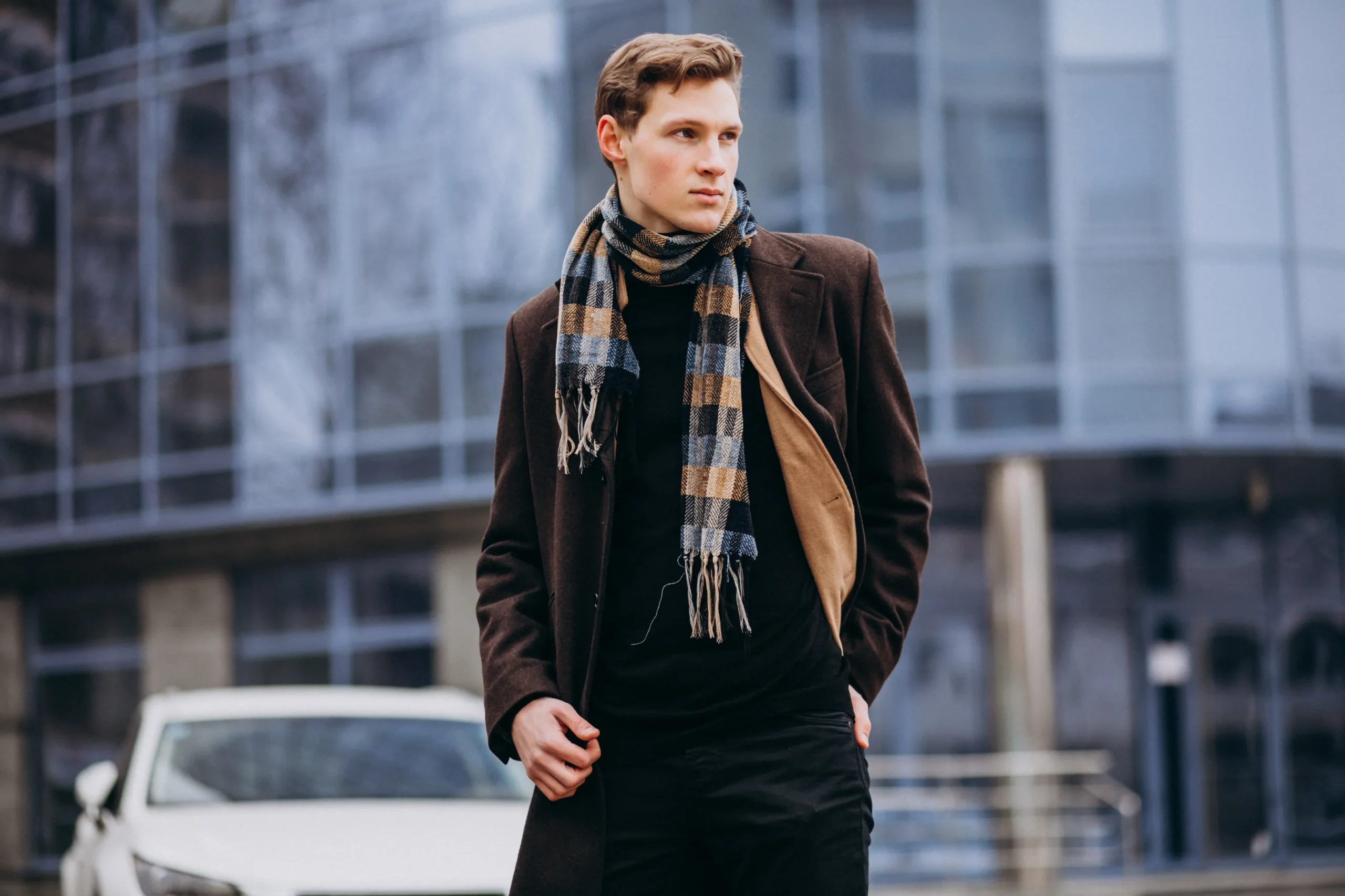
The Dark Brown Overcoat with Black Turtleneck and Black Trousers
Dark brown overcoat, black turtleneck, black trousers, chunky black shoes. A dark brown overcoat over a black turtleneck with black trousers and chunky black shoes is the outfit that proves a tailored coat can be a genuine cold-weather system, not just a formal layer. The turtleneck functions as both base and mid layer, close to the skin and warm at the neck where heat escapes fastest, and the overcoat blocks wind while adding real structure on top. Chunky shoes provide traction for icy ground. This is the outfit for real cold that still needs to look office-appropriate.
The Black Puffer Jacket with Plaid Scarf and Black Cargo Pants
Black puffer jacket, plaid scarf, black cargo pants, white sneakers. A black puffer jacket with a plaid scarf, black cargo pants, and white sneakers is the outfit that adds the one piece most cold-weather systems forget – a scarf covers the neck, a spot that loses heat fast and is easy to leave out when planning an outfit around jackets and pants alone. The puffer’s down or synthetic fill traps heat efficiently as the outer layer, and cargo pants bring genuine utility underneath. This is the outfit for the day the wind chill matters as much as the actual temperature.
The Charcoal Overcoat with Dark Crewneck Sweater and Gray Pleated Trousers
Charcoal overcoat, dark crewneck sweater, gray pleated trousers. A charcoal overcoat over a dark crewneck sweater with gray pleated trousers is the most tailored layering system in this collection – the crewneck sweater is a genuinely warm mid layer, not just a styling choice, and the overcoat handles wind block and outer insulation without needing anything bulkier underneath. Pleated trousers add a bit of room to move without sacrificing the sharp, professional line the outfit needs. This is the outfit for the cold commute that still needs to walk straight into a meeting.
The Olive Sherpa Half-Zip with Black Relaxed Pants
Olive sherpa half-zip, black relaxed pants, white sneakers. An olive sherpa half-zip with black relaxed pants and white sneakers is the outfit for moderate cold where a full three-layer system isn’t necessary – sherpa fabric alone provides real insulation, warm enough on its own for a day that doesn’t need a separate outer shell. The half-zip lets you vent heat quickly if you start moving and warming up, a small but genuinely useful detail a pullover without a zip doesn’t offer. This is the outfit for the mild cold day, one warm layer doing the job a full system would on a colder one.
The Black Puffer Jacket with Black Hoodie and Black Sweatpants
Black puffer jacket, black hoodie, black sweatpants, white sneakers. A black puffer jacket over a black hoodie with black sweatpants and white sneakers is the most complete casual layering system in this collection – the hoodie is a genuine mid layer, and sweatpants underneath complete an outfit built entirely around staying warm rather than looking dressed. All black keeps the system visually simple, letting the layering logic do the actual work. This is the outfit for the coldest, most casual day, warm from the base layer up without a single piece pretending to be something it isn’t.
The Cream Cable-Knit Sweater with Brown Trousers
Cream cable-knit sweater, brown trousers, white sneakers. A cream cable-knit sweater with brown trousers and white sneakers is the outfit for the mild cold day that doesn’t need a jacket at all – cable knit is genuinely warm on its own, thick enough to function as both mid layer and outer layer in one piece when the temperature isn’t extreme. Cream and brown together create a warm, tonal palette that suits the season without needing anything else. This is the outfit for the transitional cold day, one substantial knit doing the whole job.
The Brown Quarter-Zip Sweater with White T-Shirt and Taupe Pleated Trousers
Brown quarter-zip sweater, white t-shirt, taupe pleated trousers, black shoes. A brown quarter-zip sweater over a white t-shirt with taupe pleated trousers and black shoes is the outfit with the most temperature control in this collection – the quarter-zip lets you vent heat the moment you’re somewhere warm, without needing to remove the whole sweater the way a crewneck would require. A t-shirt underneath is the true base layer, and the sweater on top does the mid-layer insulating. Taupe pleated trousers keep the bottom half polished and comfortable. This is the outfit for the day that moves between cold outdoor stretches and warm indoor ones.
My Best Tips for Cold Weather Outfits for Men
How the base, mid, and outer layer system actually works – and how to build an outfit around it instead of around a single jacket.
Real cold weather warmth comes from three layers doing three different jobs, not from one thick piece trying to do all of them at once. Here is how each layer works and how to build an outfit around that system.
The Three-Layer System
Every genuinely warm cold-weather outfit is doing these three jobs, whether it’s obvious or not:
- → The base layer – closest to the skin, like a t-shirt or turtleneck, managing moisture and providing the first bit of warmth.
- → The mid layer – a hoodie, sweater, or knit, doing the actual insulating work by trapping body heat.
- → The outer layer – a coat, puffer, or bomber, blocking wind and holding all the trapped heat in.
- → On milder days, one substantial piece, like a cable knit sweater, can combine two of these jobs into one without needing all three separately.
Your Three Cold Weather Formulas
Three combinations matched to different levels of actual cold:
The Full System
A base tee + a hoodie or sweater mid layer + a puffer or overcoat outer layer. Built for genuinely cold, windy days.
The Combined Layer
A substantial cable knit or sherpa piece doing both mid and outer layer work at once. Right for moderate cold without much wind.
The Vented System
A base layer + a quarter-zip mid layer. Adjustable warmth for a day that moves between cold outdoors and warm indoors.
Matching the System to the Actual Temperature
Not every cold day needs all three layers, and overdoing it causes its own problems:
- → Genuine cold with wind – needs all three layers, base, mid, and a wind-blocking outer piece like a puffer or overcoat.
- → Moderate cold, little wind – often covered by one substantial mid-weight piece, like a cable knit or sherpa half-zip, alone.
- → Indoor-outdoor days – benefit most from a vented mid layer, like a quarter-zip, that adjusts without needing a full layer removed.
- → What to avoid: three heavy layers on a mild day, which leads to overheating the moment you’re moving or indoors.
The Cold Weather Fabrics
Each layer benefits from a different kind of fabric performance:
- → Cotton or knit base layers – close-fitting and comfortable against the skin, the foundation of the whole system.
- → Fleece and cable knit – genuinely insulating mid layers, trapping heat efficiently without much bulk.
- → Down or synthetic puffer fill – the most efficient outer-layer insulation for genuinely cold, windy days.
- → Wool coating – for a tailored overcoat, blocking wind while holding real structure and warmth.
The Neck – This System’s Most Overlooked Weak Point
Most cold-weather systems account for the torso and forget the neck entirely:
- → A scarf covers a spot that loses heat quickly and is easy to leave out when planning around jackets and pants alone.
- → A turtleneck solves the same problem built directly into the base or mid layer, no separate accessory required.
- → Either option matters more on a windy day, when exposed skin at the neck loses heat fastest of anywhere on the body.
- → A plaid or patterned scarf also doubles as one of the easiest ways to add visual interest to an otherwise neutral system.
What This Approach Is Not
A few boundaries worth knowing before you build the outfit:
- → Not about one heavy jacket alone – a jacket without a real mid layer underneath rarely performs as well as the three-layer system.
- → Not about maximum layers regardless of temperature – overdressing for mild cold causes its own discomfort once you’re moving or indoors.
- → Not about sacrificing style for function – a tailored overcoat over a turtleneck performs the same three-layer job a puffer and hoodie do.
- → Not about ignoring the neck – a scarf or turtleneck matters as much to overall warmth as the jacket itself.
Building the Cold Weather System
The specific pieces that generate every combination in this collection:
- → Base layers: 1 white t-shirt and 1 black turtleneck
- → Mid layers: 1 charcoal hoodie, 1 black hoodie, 1 dark crewneck sweater, 1 cream cable-knit sweater, and 1 brown quarter-zip sweater
- → A combined mid-and-outer piece: 1 olive sherpa half-zip
- → Outer layers: 1 black bomber jacket, 2 black puffer jackets, 1 dark brown overcoat, and 1 charcoal overcoat
- → 1 plaid scarf
- → Wide-leg gray pants, black trousers, gray pleated trousers, black cargo pants, black relaxed pants, black sweatpants, brown trousers, and taupe pleated trousers
- → Black shoes, chunky black shoes, white sneakers, and black shoes
- → From those pieces: every combination in this collection, and a cold weather system built layer by layer rather than jacket-first.
The cheat code: A t-shirt base layer under a hoodie mid layer under a puffer outer layer is the system that handles the widest range of genuinely cold, windy days. Each piece is doing exactly one job, and none of them is trying to do all three alone. Add a scarf or swap the base for a turtleneck on the coldest days, and the same three-layer logic scales up without needing a different outfit entirely. That is the cold weather system worth building a wardrobe around.
Copy-Paste Cold Weather Layering Checklist
- ✦ A base layer close to the skin – t-shirt or turtleneck
- ✦ A mid layer that actually insulates – hoodie, sweater, or fleece
- ✦ An outer layer that blocks wind – puffer, bomber, or overcoat, matched to how cold and windy the day actually is
- ✦ A scarf or turtleneck for the neck, especially on windy days
- ✦ A palette from: black, charcoal, brown, olive, taupe, or cream
- ✦ No three heavy layers on a mild day, and no single jacket alone on a genuinely cold one
- Three layers, three jobs. Matched to the actual temperature, not just the calendar.
Frequently Asked Questions
What are the three layers of a cold weather outfit?
A complete cold weather system has a base layer close to the skin, like a t-shirt or turtleneck, a mid layer that provides real insulation, like a hoodie or sweater, and an outer layer that blocks wind, like a puffer jacket or overcoat. Each layer does a different job, and skipping one means the remaining layers have to work harder to keep you warm.
Do you need all three layers on every cold day?
Not necessarily. On moderate cold days with little wind, one substantial mid-weight piece, like a cable knit sweater or a sherpa half-zip, can often combine mid and outer layer functions into a single garment. Genuinely cold, windy days benefit most from the full three-layer system, since wind exposure makes an outer wind-blocking layer far more important.
Why is the neck often the weak point in a cold weather outfit?
Many cold weather outfits focus on the torso and legs while leaving the neck exposed, even though it loses heat quickly, especially in windy conditions. A scarf or a turtleneck built into the base or mid layer solves this directly, and either option matters more the colder and windier the day actually is.
What’s the difference between a mid layer and an outer layer?
A mid layer, like a hoodie, sweater, or fleece, does the actual insulating work by trapping body heat close to the skin. An outer layer, like a puffer jacket, bomber, or overcoat, blocks wind and holds that trapped heat in rather than generating warmth on its own. A jacket without a real mid layer underneath generally performs worse than the same jacket paired with one.
Can a tailored coat work as part of a cold weather layering system?
A tailored overcoat can absolutely function as a genuine outer layer, especially when paired with a real mid layer like a turtleneck or crewneck sweater underneath. Wool coating blocks wind effectively while holding structure, making a tailored coat just as functional a cold weather piece as a casual puffer jacket, provided the layering underneath is doing its job.